
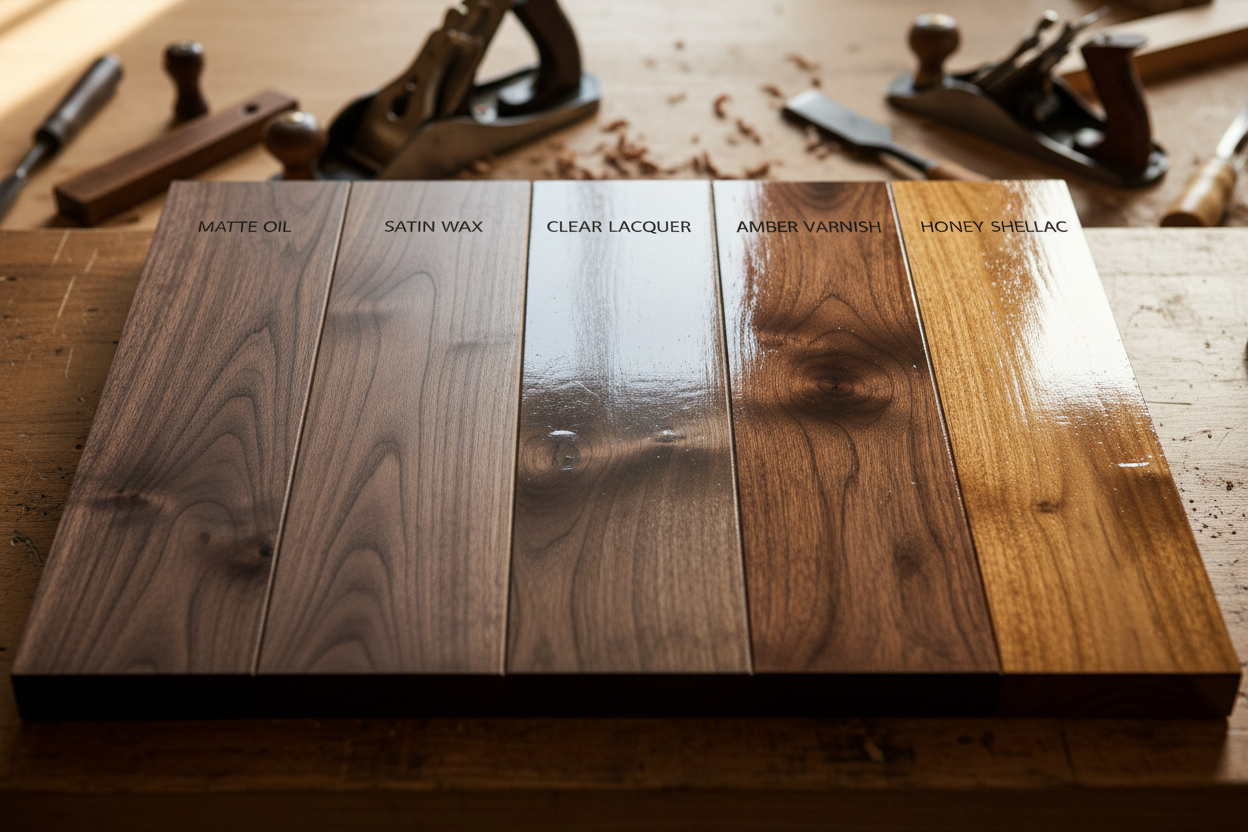
Choosing the right wood finish is one of the most consequential decisions in any woodworking project. The finish determines not just how the piece looks but how it feels, how durable it is, how it ages and how easy it is to repair. This guide compares the five main categories of wood finish — oil, wax, lacquer, varnish and shellac — so you can choose the right one for your project.
Oil finishes
Oil finishes penetrate into the wood rather than forming a film on the surface. This gives an extremely natural look and feel — you can still feel the texture of the wood grain beneath your fingers. Oils enhance the natural colour of the wood, deepening it slightly and bringing out figure and chatoyance.
The main oil types are tung oil, Danish oil, boiled linseed oil and teak oil. Tung oil provides the hardest, most water-resistant film of the pure oils. Danish oil is a blend of oil and varnish that is easier to apply and gives a slightly more protective finish. Boiled linseed oil is the traditional choice for hand tools and workshop furniture but takes the longest to cure. See our guide to applying oil finishes for detailed technique.
Best for: Furniture that will be handled frequently (dining tables, chairs, turned pieces), guitar necks, hand tools, cutting boards (food-safe oils only), any project where you want the wood to look and feel as natural as possible.
Durability: Moderate. Oils provide some moisture resistance but are not waterproof. They wear gradually and will need refreshing every year or two on heavily used surfaces. The trade-off is that they are the easiest finish to repair — simply sand the damaged area lightly and re-oil.

Wax finishes
Wax produces a soft, satiny lustre that is immediately appealing. It does not build up into a thick film like lacquer — instead, it fills the surface pores and creates a thin, buffable layer. The tactile quality of a waxed surface is distinctive: smooth, warm and slightly silky.
Beeswax, carnauba wax, and blends like Briwax are the most common choices. Carnauba is the hardest natural wax and gives the highest shine. Beeswax is softer and warmer. Most commercial furniture waxes are a blend of the two, sometimes with added solvents or micro-crystalline wax for easier application.
Best for: Antique furniture (where it is often the original finish and should be maintained), turnings and carvings, low-wear decorative pieces, and as a final top coat over other finishes like oil, shellac or lacquer to add depth and provide sacrificial protection.
Durability: Low. Wax alone offers minimal moisture or heat protection. It scuffs and wears easily. However, it is the simplest finish to maintain — just apply more wax. Wax is often used as part of a finishing system rather than on its own (for example, oil first, then wax, or shellac followed by wax).

Lacquer
Nitrocellulose lacquer is the classic film-forming finish for guitars, furniture and decorative woodwork. It dries rapidly by solvent evaporation and builds into a hard, clear film that can be polished to a mirror-like gloss. Each new coat partially dissolves into the previous one, creating a single homogeneous film — this makes lacquer remarkably easy to repair, because any damage can be blended out by applying fresh lacquer over the top.
Other lacquer types include pre-catalysed lacquer (harder and more chemical-resistant than straight nitro, widely used in production furniture), post-catalysed lacquer (the hardest and most durable, used in commercial and industrial settings), and water-based lacquer (low odour, non-yellowing, and increasingly popular for environmental reasons).
Best for: Guitars and musical instruments (nitrocellulose), fine furniture, decorative woodwork, any project requiring a high-gloss finish, painted finishes where colour clarity matters.
Durability: Moderate to high depending on type. Nitrocellulose lacquer is reasonably tough but can be damaged by solvents and will yellow over time. Pre-cat and post-cat lacquers are significantly harder and more resistant. Water-based lacquers do not yellow but are generally slightly softer. See our comparison of clear lacquers for detailed differences.

Varnish
Polyurethane varnish is the workhorse of wood finishing. It forms a thick, extremely durable film that resists water, heat, chemicals and abrasion better than any other common wood finish. Modern polyurethane is available in oil-based (warm amber tone, longer drying time) and water-based (clear, fast drying, low odour) formulations.
Traditional varnishes (spar varnish, marine varnish) are oil-resin blends that remain slightly flexible when cured, making them ideal for exterior use where the wood needs to expand and contract with the seasons. They take longer to dry than polyurethane but produce a warmer, more traditional appearance.
Best for: Kitchen and bathroom furniture, table tops, flooring, exterior woodwork, boat building, children's furniture, any surface that will see heavy daily use or exposure to moisture.
Durability: High to very high. Polyurethane is the most durable commonly available wood finish. The trade-off is that it is more difficult to repair than oil, wax or lacquer — damage to polyurethane generally requires sanding back to bare wood and re-coating, as new varnish does not dissolve into old varnish the way lacquer does.

Shellac
Shellac is a natural finish made from the secretions of the lac beetle, dissolved in alcohol. It produces a warm, amber-toned finish of exceptional depth and clarity. As a film finish, it sits somewhere between oil and lacquer in terms of build — thinner and more organic-looking than lacquer but with more surface protection than oil.
Shellac dries extremely fast (touch-dry in minutes) and is the basis for the traditional French polishing technique, which produces the most beautiful hand-applied finish achievable on wood. It is also the only finish that reliably seals in odours, stains and contaminants — which is why it is used as a primer and stain blocker (sold under brand names like Zinsser Bulls Eye).
Best for: Classical and acoustic guitars, fine furniture, antique restoration, turnings, as a sealer coat under other finishes, French polishing.
Durability: Low to moderate. Shellac is damaged by water, alcohol and heat — a wet glass will leave a white ring on a shellac surface. It is, however, one of the most repairable finishes: because fresh shellac dissolves into old shellac (just like lacquer), damage can be repaired invisibly by re-applying and re-padding.

Choosing the right finish
The right finish depends on what you are making, where it will live, and how it will be used. For a dining table that will see daily use, hot plates and spilled drinks, polyurethane varnish is the practical choice. For a guitar body, nitrocellulose lacquer (or shellac for classical instruments) gives the sound, look and repairability that players value. For a carved bowl or turned piece, oil and wax preserve the tactile pleasure of the wood. For antique restoration, the original finish type should usually be maintained — wax for waxed pieces, shellac for shellac, and so on.
There is no single best finish — only the best finish for each project. Understanding the strengths and limitations of each type lets you make an informed choice.


1 comment
This is very informative and helpful thank you. I wonder if you can advise me. I have an Iroko kitchen worktop that was made for us about twenty years ago. It had a couple of coats of oil before installation, then another two after that. Over the years I have continued to feed the surface and it has looked great, rich with a lovely sheen. In the last few years. It is showing signs of dryness in patches that are exposed to light and wear. The oil now does nothing to the wood. Is this the end of life or is there a way to get the wood back to its original health and shine? Thanks in advance.